


Synod Forum-2024
The General Assembly of the Synod on Synodality hosts a theological-pastoral forum on “The Role and Authority of the Bishop in a Synodal Church.”“The Role and Authority of the Bishop in a Synodal Church” was the title of one of the two theological-pastoral forums organized in the context of the Synod that took place Wednesday evening, 9 October.
At the Pontifical Patristic Institute Augustinianism in Rome, Professor Anna Rowlands, member of the Dicastery for the Service of Integral Human Development and holder of the St. Hilda Chair in Catholic Social Thought and Practice at the University of Durham, UK, moderated the interventions of the various speakers, who are all taking part in the General Assembly of the Synod on the theme of synodality.
The panel was comprised Cardinal-elect Roberto Repole, Archbishop of Turin and Bishop of Susa; Sister Gloria Liliana Franco Echeverri, O.D.N.; Professor Carlos Maria Galli, professor at the Faculty of Theology of the Catholic University of Argentina; Professor Matteo Visioli, priest in the diocese of Parma; and Professor Gille Routhier, professor of Ecclesiology and Practical Theology at Université Laval, in Québec, and at the Institut Catholique in Paris.Working ‘in’ and ‘for’ the Church
Rowlands introduced the first guest, Professor Galli, who framed the figure of the bishops in terms of “brothers” and “friends,” noting what he called a “novelty” of the Second Vatican Council: seeing “in the episcopate, in the ‘we of the people of God,’ the realization of the Church in its pilgrimage in the world.”
This is a foundation, for Professor Galli, that contemplates the episcopal figure committed “in” and “for” the Church, with the same “filial dignity” as its people.
“Presiding,” according to Professor Galli, implies various functions, above all “proclamation” and “witness.”
The ultimate goal must remain that of “discerning the charisms of individuals and communities, at the service of the evangelical mission.”
The model of the episcopal figure is always Jesus, capable of “governing by serving.” The ecclesiastical authority, therefore, does not possess “he totality of charisms,” Galli said. The bishop can “watch over” but not “do everything.” The ability to delegate is therefore also seen as necessary, without hiding the presence of one’s own, personal weaknesses.
Professor Galli concluded his speech with two questions: “Bishops have advisors for complex practical matters, but do they have theological advisors?” and “Bishops are accountable to God for their ministry, how can they be accountable to the people of God as a whole?”
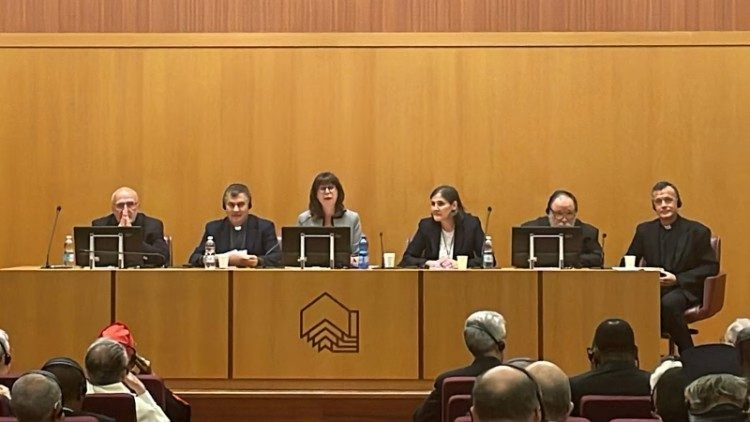
The forum at the Augustinianum
Always dependent on the people of God
Archbishop Repole followed Professor Galli, with an intervention citing the conciliar texts, which are capable of framing the ordained ministry in “precise terms” and as “service to the Church.”
Ordained ministry, however, “does not entail his independence from the portion of the people of God assigned to him.”
The Archbishop of Turin agreed with Professor Galli in portraying the figure of the bishop as one who is “capable of gathering every gift that the Spirit infuses”.
Although such statements might almost be “taken for granted,” and yet materialized thanks to the Second Vatican Council, which marked the passage “from the priesthood that had as its exemplar the priesthood directed to the Eucharist” to the “conception of the ordained ministry divided into three degrees and aimed at proclamation, celebration and pastoral guidance.
This, Archbishop Repole noted, is a “fundamentally Ignatian” model, referring to St Ignatius of Antioch. However, he continued, it represents “the model of a bishop in a small Church,” which can be interpreted in the figure of one who “daily presides over the Eucharist.”
Such a vision, he said, when applied “to different Church models, can create short circuits that this Synod can dissolve.”
‘Get to it!’
Sister Gloria Liliana Franco Echeverri took the floor next, with an intervention in which she told the bishops present in the hall that their call makes them “our servants and brothers.”
She invited them to pray “that you may succeed in configuring yourselves to the style of Christ.”
Sister Gloria asked the pastors for greater inclusion in their agendas, “without wasting time on bureaucratic matters.”
“Don’t cover up, don’t bury anything,” the nun said about the dramatic scourge of abuse, adding “no abuse of any kind” must “extinguish the voice of the Pastor.”
The bishop, Sister Echeverri continued, is invited to lower himself to whisper to the members of his community, “You exist, you are important.”
Another point touched on was that of the Church authority’s knowledge of the reality in which it operates. “Be humble, have the humility of the one who learns,” she said.
There will also come a time “when you will feel outdated,” Sister Gloria continued. Nonetheless, she encouraged the bishops to “try to foster networks, bonds, relationships.”
Sister Gloria concluded her remarks by returning to the concept of the bishop as “brother”: “No one will stop you from more loving than us,” she said. “So get to it!”
‘In the midst’ of the assembly
The fourth guest speaker was Professor Routhier, with a message focusing on the nature of the bishop as “brother among brothers.” Speaking of the bishops’ functions, several prepositions are used, but rarely “with,” “in,” or “in the midst of,” (referring to the Christian people), according to the professor. The bishop’s position “is therefore very complex. However, he is never separated from the community he presides over.”
Lumen gentium, Routhier noted, “presents first the people of God, and then tells us about the bishops.” Such must be “the structure of the Church: an assembly within which the bishop figure is inserted.”
When the bishop prays, he does so not “in his own name,” but inclusive of the whole assembly.
The need for transparency
Finally, Professor Matteo Vasili took the lectern in the Aula Magna. His speech focused on the concept of “power,” divided into the dimensions of “order” and “jurisdiction”: the former referring to sacramental acts, the latter to the functions of government.
This distinction has three consequences, Vasili maintained. “Beyond the doctrine to be adopted,” it is necessary “to think of the ministry as a shared government.” Consequently, it should not tend to “monarchical” tendencies despite the conferral of “the fullness of the sacrament of Orders.”
Secondly, the bishop “can and must” delegate to the suitable members of the lay faithful “tasks of responsibility in the government of the Church.” “Can and must,” Visioli repeated, insisting that “power” cannot not hold bishops “back from having to account for their actions according to a logic of transparency.”
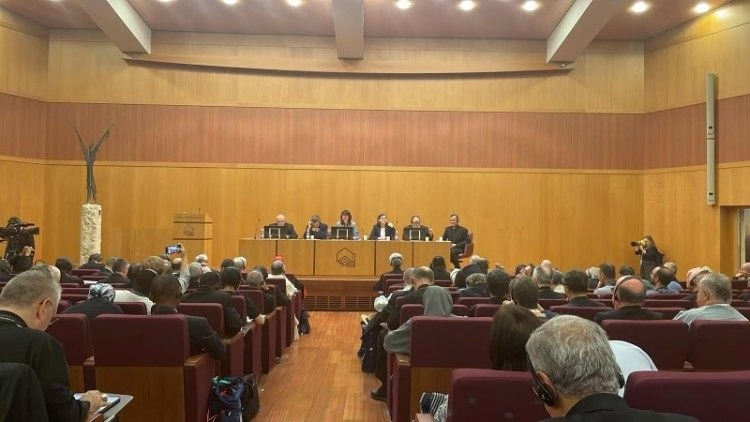
The Aula Magna of the Augustinianum
Questions from the audience
Space was then given to questions from the audience. Professor Galli recalled a book, written by an “unknown ecclesiologist” in 1940 entitled Ecclesiologo in divenire [“Ecclesiology in the making”], which foresaw how Lumen gentium would bring “unforeseeable and enormous consequences for the future of the Church.” One of them is precisely the experience of the Synod, based on “mutual listening.”
In this sense, Galli noted the presence of “tension between listening to God and listening to others.” A fracture that must not exist. “We must discern in prayer, in our conscience. In this sense there is much to be done.” The final example brought by Galli was the double canonisation of John XXIII and John Paul II by Pope Francis.
Being transparent, being able to take a step back
On the sidelines of the forum, when asked by Vatican Media about one of “transparency,” Professor Visioli explained that there are two aspects to be taken into consideration: “One is to tell, to give an account of what one does, also of the motivations as well as the choices of government. The other, more hidden aspect that, in my opinion, deserves to be rediscovered, is the right and duty of any believer to ask the bishop or those who govern for an account of the reasons for his choices.”
“And this,” the professor clarified, “not to put him under investigation or make him feel uncomfortable, but, on the contrary, to remove him from that solitude in taking decisions that a bishop so often feels about himself.”
In the same vein, the priest pointed to “engagement and dialogue with other bishops” as a way for a pastor to understand when to delegate and take a step back. “Discernment,” Vasili said, “is never done alone, this Synod teaches us that, and therefore all questions regarding ‘when can I’ must be brought to an appropriate forum for discernment, which is that of ecclesial communion: bishops among bishops, bishops with the people of God.”
“The answer,” Vasili concluded on a hopeful note, “will certainly come.”
Thank you for reading our article. You can keep up to date by subscribing to our daily newsletter. Just click here
Leave a Reply