


Cardinal Parolin receives Prize,
The Path to Peace Foundation’s award, stating he accepted it on behalf of the Secretariat of State, “which works tirelessly for the Pope to promote justice in our world.”
By Isabella H. de Carvalho
On May 19, Cardinal Secretary of State Pietro Parolin accepted the award presented by the Path to Peace Foundation, established in 1991 by then-Archbishop Renato Raffaele Martino, during his tenure as the Permanent Observer of the Holy See to the United Nations.
At the ceremony in New York, the Cardinal expressed his gratitude for the award. “I am deeply honoured to receive this year’s Path to Peace Award,” he said and immediately shared that the award was for more than just himself. “I accept it on behalf of the Holy See, and, above all, on behalf of the Secretariate of State, which works tirelessly for and on behalf of the Roman Pontiff to advance the cause of peace and justice in our world.”
Continuing, Cardinal Parolin explained that “the honour bestowed this evening transcends the personal and embodies the collaborative spirit that underpins our sacred mission in a world crying out for healing and reconciliation.”
He emphasized that at the core of the Holy See’s mission is the path laid out by successive Popes in their pursuit of a world without conflict.
2025 marks the 60th anniversary of Pope St. Paul VI’s historic visit to the United Nations, the 30th anniversary of Pope St. John Paul II’s second visit, and the 10th anniversary of Pope Francis’ address to the General Assembly. Reflecting on these historic moments, Cardinal Parolin highlighted how “each Pope, in his time, has illuminated the path toward a more just and peaceful world, offering wisdom that transcends borders.”
The Words of Past Popes
The Cardinal recalled the words of the different Pontiffs, beginning with Pope Paul VI, who proclaimed with “prophetic clarity” in 1965 that lasting peace must be “rooted in spiritual and moral renewal.” Parolin stressed that these words remain urgently relevant today, noting that “technological progress without moral development leaves humanity dangerously unbalanced.”
He then cited Pope John Paul II’s 1979 appeal, urging humanity to confront its capacity for both immense good and unspeakable evil—emphasizing the intrinsic and inviolable dignity of every person. The Polish Pontiff drew from his own experience under totalitarian regimes and conflict, describing the Holocaust and World War II “not only as historical events, but as ongoing moral challenges that still demand our response.”
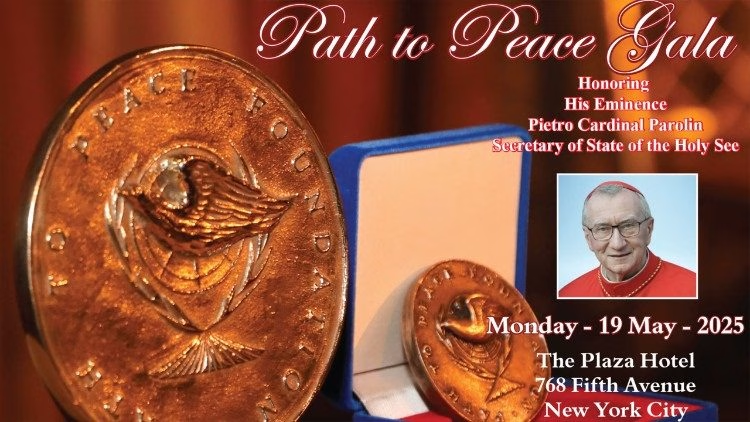
Cardinal Parolin received the Path to Peace Foundation Award in New York
The Secretary of State also recalled the words of Pope Benedict XVI, who in 2008 affirmed the “universal and immutable truths” that underpin human rights and insisted that the defence of human dignity must be seen as the collective responsibility of the entire international community.
Moving on to the most recent Pope to visit the UN, Cardinal Parolin referenced Pope Francis’s 2015 address, where he stressed “the interconnectedness of environmental protection and social justice,” along with his powerful critique of “throwaway culture.”
Now, he added, “this tradition continues” with Pope Leo XIV, who in his first words as Pope called for a peace that is “disarmed and disarming”—a “positive force” in a world “torn apart by conflict and division.” The Secretary of State also noted the significance of the new Pope’s choice of name, emphasizing the Church’s social teaching in the context of today’s rapid technological progress, which continues to challenge human dignity and justice.
The Holy See and the United Nations: A collaboration for peace
In this context, Cardinal Parolin reiterated that this Path to Peace Award is “a recognition of the Holy See’s supportive – though sometimes critical – relationship with the United Nations, and also a tribute to all those dedicated individuals who assist the Pope in his mission.”
He repeated that “path to peace must be walked with patience and perseverance, with courage and creativity,” and that “the Popes have shown us the way.”
Read also

19/05/2025
Cardinal Parolin: Pope Leo XIV calls for diplomacy of encounter
The Secretary of State also called on the United Nations to continue renewing itself—not only institutionally, but also morally and spiritually. The real impact of this effort, he said, will not be seen “in treaties or resolutions,” but rather “in the genuine transformation of the human heart toward greater justice, compassion, and reverence for the dignity of every person.”
Concluding, Cardinal Parolin thanked the Path to Peace Foundation for its support of the mission of the Holy See’s Permanent Observer to the UN and its ongoing contribution to the Church’s mission of peace.
Thank you for reading our article. You can keep up-to-date by subscribing to our daily newsletter. Just click here
Leave a Reply